Reta 10mg
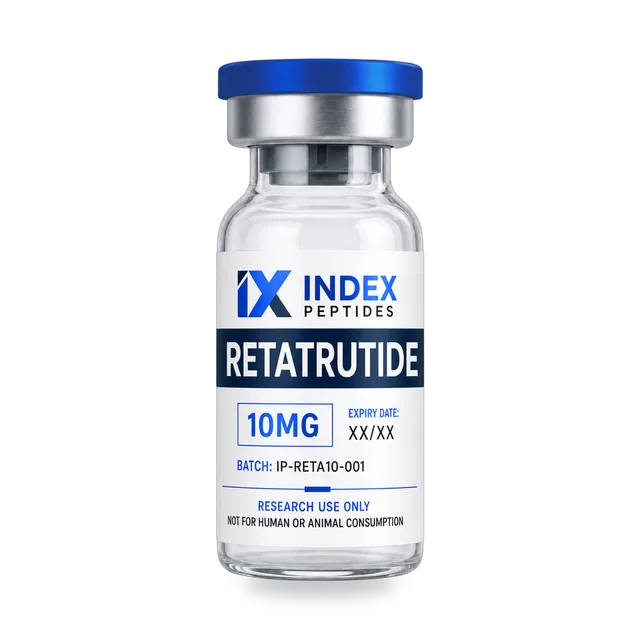
£59.99 per vial · Peptides · Research use only
Only 1 left
About Reta 10mg
Reta 10mg is a synthetic 39-residue modified peptide, supplied as lyophilised powder in a single vial for in-vitro laboratory research.
Product specifications
- Compound
- Reta
- Declared content
- 10mg per vial
- Format
- Lyophilised powder
Batch documentation
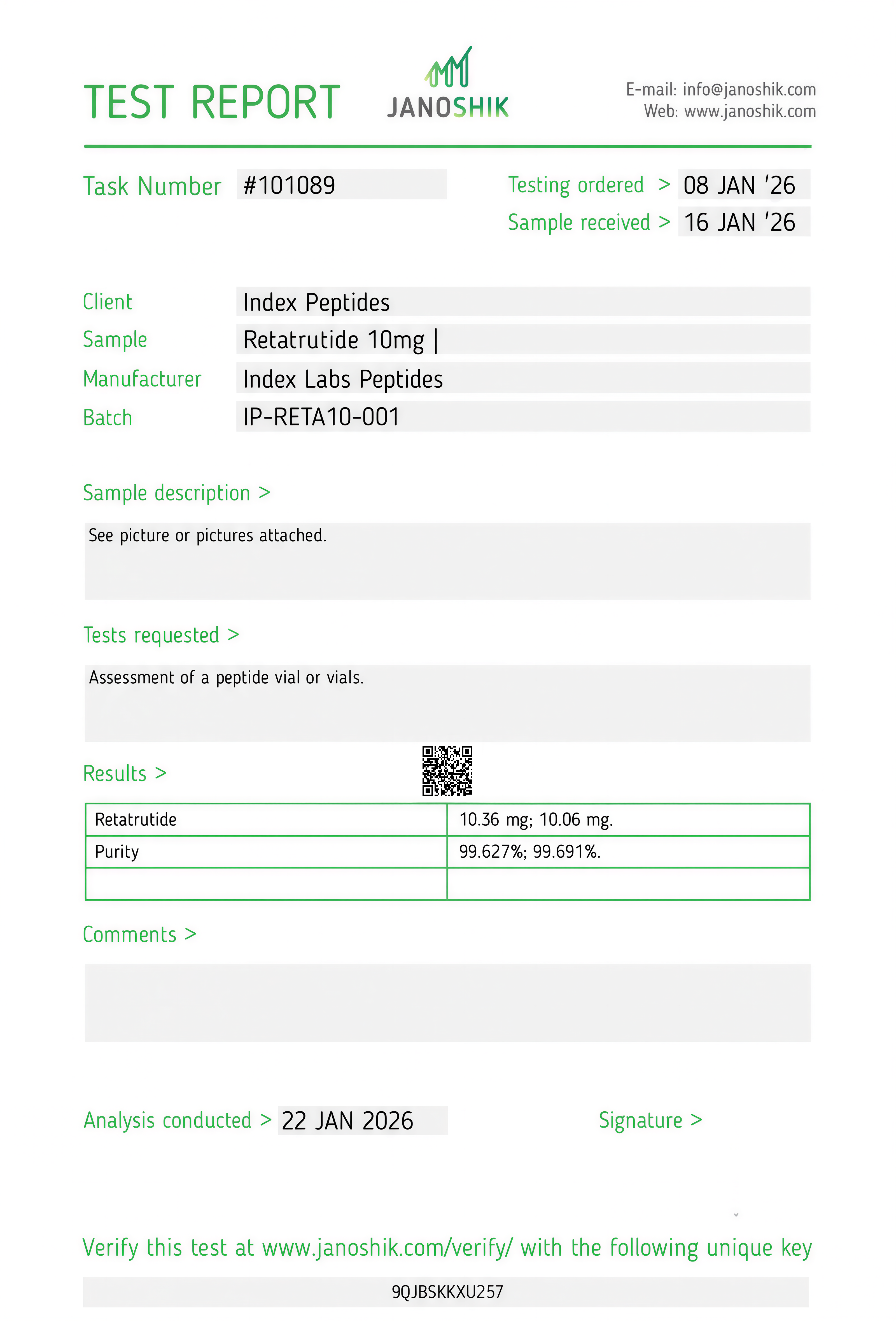
The current published lot is IP-RETA10-001. The batch record from Janoshik Analytical (CZ), dated 22 January 2026, lists reported purity of 99.627% (RP-HPLC) and measured content of 10.36 mg/vial.
View the certificate of analysis →
Intended use
For in-vitro laboratory research only. Not for human or veterinary use.
Technical notes and further reading
- CAS number
- 2381089-83-2
- Molecular formula
- C221H342N46O68
- Molecular weight
- 4731.3 g/mol
- Sequence
- 39-residue modified peptide
Specification
| SKU | RT10 |
|---|---|
| Compound | Reta |
| Price | £59.99 per vial |
| Format | 10mg per vial |
| Availability | In stock |
| CAS number | 2381089-83-2 |
| Molecular formula | C221H342N46O68 |
| Molecular weight | 4731.3 g/mol |
| Sequence | 39-residue modified peptide |
| Published batch / lot | IP-RETA10-001 |
| Reported purity | 99.627% (RP-HPLC) |
| Measured content | 10.36 mg/vial |
| Identity status | LC-MS identity result not published |
| Tested by | Janoshik Analytical (CZ) |
| Report date | 2026-01-22 |
| Storage | Lyophilised: −20 °C, protect from light |
| Intended use | In-vitro laboratory research only |
Frequently asked questions
What does "triple agonist" describe?
Activity at three receptors from one molecule. Two of them are incretin receptors — those for glucose-dependent insulinotropic polypeptide and for glucagon-like peptide-1 — and the third is the glucagon receptor itself. The term is a receptor-pharmacology classification used in in-vitro binding and signalling studies; it says nothing about any application of the material, which is supplied for laboratory research only.
Why does the lipid modification matter analytically?
The C20 diacid chain makes the molecule markedly more hydrophobic than an unmodified peptide of the same length, which pushes reversed-phase retention late and can complicate separation from closely related synthesis by-products. It also adds a defined mass increment that identity confirmation checks for.
Does mass accuracy matter more at this molecular weight?
Yes. At around 4.7 kDa a single missing or substituted residue is a small fractional change in the total, so identity work needs enough resolution to see it, read alongside the purity trace rather than instead of it. This is one of the compounds where the analytical detail on a certificate carries the most weight.
Documentation & batch verification
The current released lot is IP-RETA10-001, tested 2026-01-22 by Janoshik Analytical (CZ): RP-HPLC purity 99.627% (RP-HPLC), measured content 10.36 mg/vial, identity Purity confirmed (RP-HPLC). The full report for this lot is published and can be checked online — verify this batch. See the full record for lot IP-RETA10-001 or all published certificates of analysis.
Published batch records show the laboratory, report date, purity and measured content where reported. Check the certificate for the exact lot: an HPLC purity result does not establish LC-MS identity, sterility or suitability for human or animal use. Review the published batch record before ordering.
Request an invoice · Verify a batch
Research use only. Not for human or animal consumption.