MOTS-c 10mg

£25.99 per vial · Peptides · Research use only
About MOTS-c 10mg
MOTS-c 10mg is a synthetic 16-residue mitochondrial-derived peptide, supplied as lyophilised powder in a single vial for in-vitro laboratory research.
Product specifications
- Compound
- MOTS-c
- Declared content
- 10mg per vial
- Format
- Lyophilised powder
Batch documentation
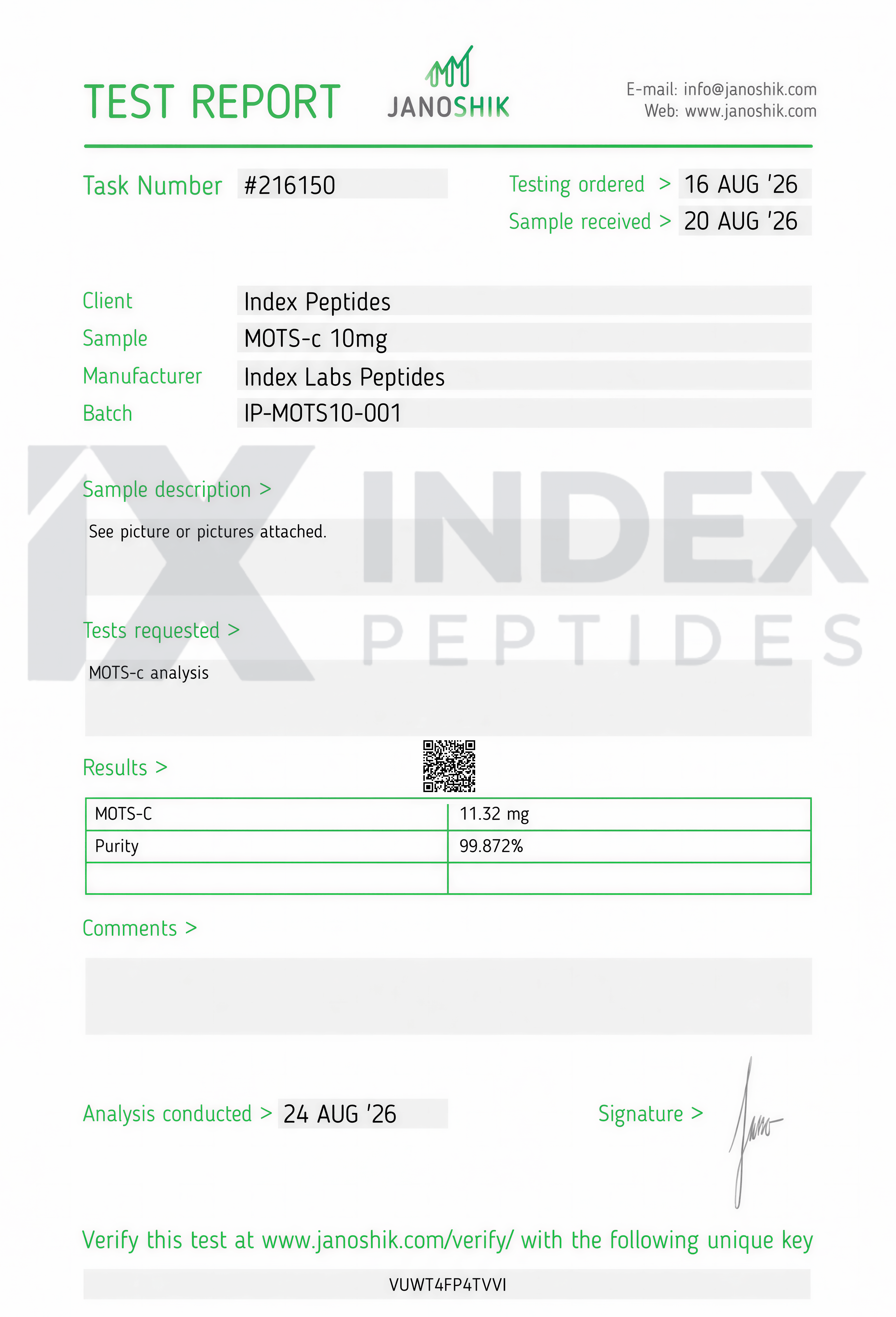
The current published lot is IP-MOTS10-001. The batch record from Janoshik Analytical (CZ), dated 24 August 2026, lists reported purity of 99.872% (RP-HPLC) and measured content of 11.32 mg/vial.
View the certificate of analysis →
Intended use
For in-vitro laboratory research only. Not for human or veterinary use.
Technical notes and further reading
- CAS number
- 1627580-64-6
- Molecular formula
- C101H152N28O22S2
- Molecular weight
- 2174.6 g/mol
- Sequence
- MRWQEMGYIFYPRKLR
Specification
| SKU | MOTC10 |
|---|---|
| Compound | MOTS-c |
| Price | £25.99 per vial |
| Format | 10mg per vial |
| Availability | In stock |
| CAS number | 1627580-64-6 |
| Molecular formula | C101H152N28O22S2 |
| Molecular weight | 2174.6 g/mol |
| Sequence | MRWQEMGYIFYPRKLR |
| Published batch / lot | IP-MOTS10-001 |
| Reported purity | 99.872% (RP-HPLC) |
| Measured content | 11.32 mg/vial |
| Identity status | LC-MS identity result not published |
| Tested by | Janoshik Analytical (CZ) |
| Report date | 2026-08-24 |
| Storage | Lyophilised: −20 °C, protect from light |
| Certificate of analysis | Published for lot IP-MOTS10-001 — download it from this page, or request a copy |
| Intended use | In-vitro laboratory research only |
Buying MOTS-c 10mg in the UK
MOTS-c, also written MOTS C, is supplied here as a 10mg lyophilised research vial. It is a 16-residue peptide, and the product identity should match the sequence or specification required for your laboratory work. Use the available lot report to assess the material instead of relying on the compound name alone. Check this page for the current UK price and dispatch status.
What does the research on MOTS-c investigate?
MOTS-c is a sixteen-residue peptide and it is unusual in origin as well as in sequence: rather than being encoded by a gene in the ordinary way, it is translated from a short open reading frame within the mitochondrial genome, which is what places it in the mitochondrial-derived peptide literature. The sequence carries a distinctive analytical burden. It contains two methionines and two tryptophans, which between them account for four of its sixteen residues, and those are the two residues most susceptible to oxidation. On a purity trace this compound accumulates oxidative products more readily than almost anything else listed here, and because the chain is short, each sixteen dalton addition is a large fraction of the total mass and clearly resolved. The chain also carries several basic residues, giving it a net positive charge. This page describes the material and its documentation only.
Who can buy MOTS-c?
MOTS-c is supplied strictly as a research chemical for in-vitro laboratory research. Products are sold exclusively to qualified researchers and licensed laboratories.
At checkout the buyer confirms that they are 18 or over, are buying in the course of research, and are responsible for handling, storing and disposing of the material in line with their laboratory's procedures. MOTS-c is not for human or veterinary use.
We only answer questions about specifications, documentation and orders.
How are identity and quality assured?
Each released lot is tested and the result is published, rather than the material being described as high purity on the strength of a supplier's word. Purity is measured by reversed-phase HPLC at an independent laboratory. The laboratory used for every lot published so far is Janoshik Analytical, in the Czech Republic, and the result is stated alongside the measured content against label so the two can be read together.
The report carries the lot number printed on the vial, which is the part that matters. A certificate showing a result without a lot number cannot be tied to the vial in front of you, and a certificate for a different lot tells you nothing about yours. Matching the printed number on the label to the number on the report is a five second check and it is the whole point of publishing both.
Identity confirmation by mass spectrometry is a separate test and is ordered as an add-on, so the figures published here come from RP-HPLC purity testing unless a report says otherwise. Where no report is published for a listing yet, the documentation held for the lot being shipped can be requested before you order. We would rather send you what exists than let you assume a certificate is available when it is not.
Synthesis and supply
Peptide material is built by solid-phase synthesis, purified by preparative HPLC, then lyophilised. Lyophilisation freezes the solution and removes the solvent under vacuum, which is why the vial arrives holding a cake or powder rather than a liquid and why a solvent has to be added before the material can be worked with. Removing water also removes the main route by which a peptide degrades in storage, which is the reason the format is used.
Sequence length and modification are what make batches differ in difficulty. Every coupling step is an opportunity for a truncated or deleted by-product, and a heavily modified or long chain presents more of them, which is why the purity trace rather than the headline figure is what a certificate is read for. Vials are filled and labelled with the lot number, and the lot number is what the report and the verification lookup resolve against.
With four oxidation-prone residues in a sixteen-residue chain, storage conditions affect the purity trace of this compound more than they do for most materials here, and that is worth remembering when comparing a fresh batch against one that has been sitting on a shelf.
External resources for researchers
These are the public reference sources we use when checking the identity of MOTS-c, and the ones worth going to before relying on anything stated on a product page, including this one.
- PubChem — Compound records, computed properties, depositor-supplied identity data.
- CAS Common Chemistry — CAS Registry lookups where a registry number is known.
- ChEBI — Curated chemical ontology entries with cross-references.
- Europe PMC — Primary literature search by compound name, sequence or registry number.
- Certificate hub — Reports published for the lots released so far.
Frequently asked questions
What does "mitochondrially derived" mean for this sequence?
The open reading frame sits within the mitochondrial 12S rRNA gene rather than in nuclear DNA, and peptides in this small group are read using the mitochondrial genetic code, which differs from the standard code at several codons. It is an unusual origin among research peptides — the material supplied here is nonetheless made by ordinary solid-phase chemistry.
Is the peptide prone to aggregation?
The middle of the sequence, Gly-Tyr-Ile-Phe-Tyr, is hydrophobic enough that poorly matched solvent conditions can give cloudy or incompletely dissolved preparations. Solvent selection belongs to the experimental design; support cannot specify conditions for a given assay.
How strongly charged is the peptide at neutral pH?
Three arginines and a lysine against one glutamate leave it strongly cationic at neutral pH. That governs its behaviour on ion-exchange columns and its tendency to adsorb to anionic surfaces such as untreated plasticware, which is why low-binding vessels are a usual precaution for cationic peptides at low concentration.
Is MOTS-c supplied for human or veterinary use?
No. MOTS-c is supplied as a lyophilised powder in a sealed vial and is supplied strictly as a research chemical for in-vitro laboratory research. Products are sold exclusively to qualified researchers and licensed laboratories, and buyers confirm they are 18 or over and purchasing in the course of research. We only answer questions about specifications, documentation and orders.
How is the purity figure measured, and what does it actually tell me?
Purity is measured by reversed-phase HPLC at an independent laboratory, and the result is published with the method conditions rather than as a bare percentage. The figure is the proportion of the UV-absorbing material in the chromatogram that elutes as the target peak. It describes the sample as analysed; it is not a statement about what the material is for. A high figure alongside a clean chromatogram is the useful combination, which is why the report is worth reading rather than the headline number alone.
What documentation comes with a batch?
Each released lot carries a number printed on the vial label and a report stating purity by RP-HPLC, measured content against label, and the testing laboratory. Reports published so far are listed on this page and collected on the certificate hub, and each carries a lot number that can be checked against the vial in front of you. Where a report is not yet published for a listing, ask before ordering and we will send the documentation that exists for the lot being shipped.
How should MOTS-c be stored?
In the form supplied, as a lyophilised powder, the material is stable kept cold, dry and dark. For powder, that means a freezer at around minus 20 degrees Celsius, desiccated, with the vial sealed and shielded from light, which is how it should stay until you are ready to work with it. Bringing a vial to room temperature before opening avoids condensation on the contents. Once in solution the material is less stable than the powder and should be kept cold and used within a short working window. Choosing a solvent and storage conditions for your own work is your call, not ours.
Do I need bacteriostatic water to prepare it?
A lyophilised powder needs a solvent added before it can be worked with. Bacteriostatic water, which is water with 0.9% benzyl alcohol, is the common choice because the preservative extends the working life of the solution once the vial has been opened, and we supply it in 3ml and 10ml vials. It is not the only option: where a method cannot tolerate benzyl alcohol, use the solvent the method specifies. The choice affects the sample, so it belongs to the researcher.
How and when is an order shipped?
Orders are dispatched from the United Kingdom. An order placed before 4pm on a working day is collected the same day; weekends and bank holidays roll forward to the next working day. Delivery is tracked, and shipping is free on UK orders over 30 pounds, with tracked 48 hour service at 3.65 pounds below that. Tracking is sent when the parcel is collected, so the first scan is usually visible the same evening.
Why does this peptide oxidise so readily?
It contains two methionine and two tryptophan residues in a chain of only sixteen, and those two residue types are the most susceptible of the standard amino acids to oxidation. Four sites out of sixteen is a high proportion. Each oxidation adds sixteen daltons, so successive products appear as a series of closely spaced peaks rather than a single distant impurity, which is what makes oxidation easy to mistake for poor synthesis on a chromatogram.
What does it mean that the peptide is mitochondrial-derived?
That its sequence is not encoded in the nuclear genome in the usual way, but read from a short open reading frame within mitochondrial DNA. That is what makes it part of a small and comparatively recently described group of peptides, and it is the reason the published literature discusses it in the context of communication between the mitochondrion and the rest of the cell. It is a statement about where a sequence comes from, not about any application of the material.
How should the powder be handled to limit oxidation?
Keep the vial sealed, cold and dark until needed, and limit how often it is opened and how long it is exposed to air. Reduce the number of freeze-thaw cycles rather than repeatedly returning a vial to the freezer, since each cycle is another exposure. Once in solution the material is considerably more vulnerable than the dry powder, so extended storage in solution is best avoided.
Is a short peptide easier to characterise than a long one?
In some ways yes and in others no. Mass confirmation is unambiguous at sixteen residues because there is little room for a hidden structural difference to hide in. But that same small size means a single modification is a large fractional change, so the material is more sensitive to handling and the purity trace carries more information about storage than it would for a longer chain.
Documentation & batch verification
The current released lot is IP-MOTS10-001, tested 2026-08-24 by Janoshik Analytical (CZ): RP-HPLC purity 99.872% (RP-HPLC), measured content 11.32 mg/vial, identity Purity confirmed (RP-HPLC). The full report for this lot is published and can be checked online — verify this batch. See the full record for lot IP-MOTS10-001 or all published certificates of analysis.
Published batch records show the laboratory, report date, purity and measured content where reported. Check the certificate for the exact lot: an HPLC purity result does not establish LC-MS identity, sterility or suitability for human or animal use. Review the published batch record before ordering.
Order MOTS-c 10mg online — UK dispatch · Request an invoice · Verify a batch
Research use only. Not for human or animal consumption.