GHK-Cu + BPC-157 + TB-500 Blend 70mg

£64.99 per vial · Peptide blends · Research use only
About GHK-Cu + BPC-157 + TB-500 Blend 70mg
GHK-Cu + BPC-157 + TB-500 Blend 70mg is a blend of BPC-157, GHK-Cu and TB-500, supplied as lyophilised powder in a single vial for in-vitro laboratory research.
Product specifications
- Compound
- GHK-Cu + BPC-157 + TB-500 Blend
- Declared content
- 70mg per vial
- Format
- Lyophilised powder
Declared blend composition per vial: BPC-157 10mg; GHK-Cu 50mg; TB-500 10mg.
Batch documentation
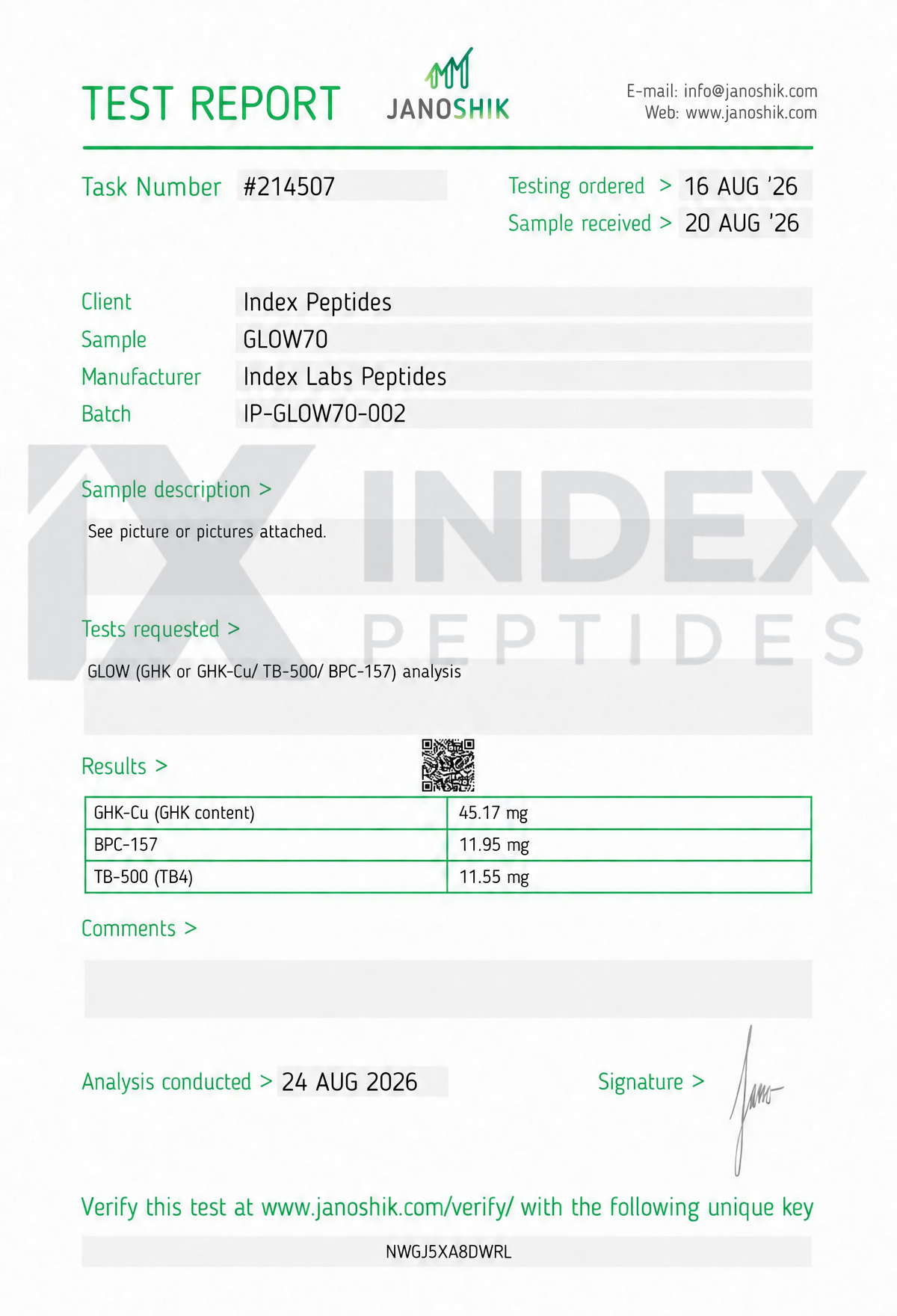
The current published lot is IP-GLOW70-002. The batch record from Janoshik Analytical (CZ), dated 24 August 2026, lists measured content of GHK-Cu 60.61 mg · BPC-157 11.99 mg · TB-500 11.41 mg.
View the certificate of analysis →
Intended use
For in-vitro laboratory research only. Not for human or veterinary use.
Technical notes and further reading
Specification
| SKU | BBG70 |
|---|---|
| Compound | GHK-Cu + BPC-157 + TB-500 Blend |
| Price | £64.99 per vial |
| Format | 70mg per vial |
| Availability | In stock |
| Declared composition | BPC-157 10mg + GHK-Cu 50mg + TB-500 10mg |
| Component: BPC-157, 10mg | CAS 137525-51-0 · C62H98N16O22 · MW 1419.6 g/mol |
| Component: GHK-Cu, 50mg | CAS 89030-95-5 · C14H22CuN6O4 · MW 401.9 g/mol |
| Component: TB-500, 10mg | CAS 885340-08-9 · C38H68N10O14 · MW 889.0 g/mol |
| Published batch / lot | IP-GLOW70-002 |
| Reported purity | Stated on the certificate of analysis — available on request |
| Measured content | GHK-Cu 60.61 mg · BPC-157 11.99 mg · TB-500 11.41 mg |
| Identity status | LC-MS identity result not published |
| Tested by | Janoshik Analytical (CZ) |
| Report date | 2026-08-24 |
| Storage | Lyophilised: −20 °C, protect from light |
| Certificate of analysis | Published for lot IP-GLOW70-002 — download it from this page, or request a copy |
| Intended use | In-vitro laboratory research only |
GHK-Cu + BPC-157 + TB-500 Blend 70mg: UK price and composition
The GHK-Cu + BPC-157 + TB-500 Blend 70mg research vial declares 50mg GHK-Cu, 10mg BPC-157 and 10mg TB-500, totalling 70mg. Compare a three-peptide blend listing by those component quantities, rather than treating 70mg as the amount of each peptide. The published report records component measurements; check it against the lot supplied. Current price, availability and UK ordering options appear on this page.
- GHK-Cu 50mg — Compare the current price, availability and batch record.
- BPC-157 + TB-500 Blend 20mg — Compare the current price, availability and batch record.
What does the research on GHK-Cu + BPC-157 + TB-500 Blend investigate?
This blend carries three components and one of them is a metal complex, which makes it the most analytically interesting mixture in this catalogue. GHK-Cu is a tripeptide bound to a copper ion, and the copper is what gives it colour and what makes its presence measurable - the deep blue of the solution is a direct indication that the complex is intact. Alongside it sit BPC-157 and TB-500, neither of which carries any of the residues that drive peptide instability. Between them the components display three different kinds of analytical question at once: a metal complex whose stoichiometry has to be confirmed, two peptides whose ratio to each other has to be established, and a mixture in which the copper can be displaced by competing chelators and take the colour with it. This page describes the material and its documentation only.
Who can buy GHK-Cu + BPC-157 + TB-500 Blend?
GHK-Cu + BPC-157 + TB-500 Blend is supplied strictly as a research chemical for in-vitro laboratory research. Products are sold exclusively to qualified researchers and licensed laboratories.
At checkout the buyer confirms that they are 18 or over, are buying in the course of research, and are responsible for handling, storing and disposing of the material in line with their laboratory's procedures. GHK-Cu + BPC-157 + TB-500 Blend is not for human or veterinary use.
We only answer questions about specifications, documentation and orders.
How are identity and quality assured?
Each released lot is tested and the result is published, rather than the material being described as high purity on the strength of a supplier's word. Purity is measured by reversed-phase HPLC at an independent laboratory. The laboratory used for every lot published so far is Janoshik Analytical, in the Czech Republic, and the result is stated alongside the measured content against label so the two can be read together.
The report carries the lot number printed on the vial, which is the part that matters. A certificate showing a result without a lot number cannot be tied to the vial in front of you, and a certificate for a different lot tells you nothing about yours. Matching the printed number on the label to the number on the report is a five second check and it is the whole point of publishing both.
Identity confirmation by mass spectrometry is a separate test and is ordered as an add-on, so the figures published here come from RP-HPLC purity testing unless a report says otherwise. Where no report is published for a listing yet, the documentation held for the lot being shipped can be requested before you order. We would rather send you what exists than let you assume a certificate is available when it is not.
Synthesis and supply
Peptide material is built by solid-phase synthesis, purified by preparative HPLC, then lyophilised. Lyophilisation freezes the solution and removes the solvent under vacuum, which is why the vial arrives holding a cake or powder rather than a liquid and why a solvent has to be added before the material can be worked with. Removing water also removes the main route by which a peptide degrades in storage, which is the reason the format is used.
Sequence length and modification are what make batches differ in difficulty. Every coupling step is an opportunity for a truncated or deleted by-product, and a heavily modified or long chain presents more of them, which is why the purity trace rather than the headline figure is what a certificate is read for. Vials are filled and labelled with the lot number, and the lot number is what the report and the verification lookup resolve against.
A copper complex inside a blend adds a requirement that the other components do not have: the copper content relative to the peptide has to be confirmed, which is a different measurement to a purity run.
External resources for researchers
These are the public reference sources we use when checking the identity of GHK-Cu + BPC-157 + TB-500 Blend, and the ones worth going to before relying on anything stated on a product page, including this one.
- PubChem — Compound records, computed properties, depositor-supplied identity data.
- CAS Common Chemistry — CAS Registry lookups where a registry number is known.
- ChEBI — Curated chemical ontology entries with cross-references.
- Europe PMC — Primary literature search by compound name, sequence or registry number.
- Certificate hub — Reports published for the lots released so far.
Frequently asked questions
Why does the copper complex dominate the vial?
Two factors compound. It is the largest single mass, 50mg of the 70, and at 401.9 g/mol it is also by far the lightest of the three molecules, so it contributes close to nine in every ten molecules present. Any calculation built on the 70mg total will misstate all three components.
Is a three-component blend harder to document than a single peptide?
A blend report needs to distinguish the components. Review the published certificate for the measurements reported for each component, alongside the declared composition for this listing.
Does the copper component impose conditions the peptides do not?
It does. GHK-Cu is a coordination complex, so anything competing for the copper — a chelating buffer component, strong acid, a reducing agent — alters that component while leaving the two peptides untouched. A blend containing a metal complex has a narrower usable window of conditions than the peptides alone would.
Is GHK-Cu + BPC-157 + TB-500 Blend supplied for human or veterinary use?
No. GHK-Cu + BPC-157 + TB-500 Blend is supplied as a lyophilised powder in a sealed vial and is supplied strictly as a research chemical for in-vitro laboratory research. Products are sold exclusively to qualified researchers and licensed laboratories, and buyers confirm they are 18 or over and purchasing in the course of research. We only answer questions about specifications, documentation and orders.
The label on a blend states a total weight, not a per-component weight. How should that be read?
A blend figure is an arithmetic total of the components weighed separately, so a vial labelled 20mg of a two-component blend contains 10mg of each rather than 20mg of each. The declared split per vial is stated on this page and in the specification table. That matters for any molar or concentration calculation: work from the per-component figure, not the label total.
How is the purity figure measured, and what does it actually tell me?
Purity is measured by reversed-phase HPLC at an independent laboratory, and the result is published with the method conditions rather than as a bare percentage. The figure is the proportion of the UV-absorbing material in the chromatogram that elutes as the target peak. It describes the sample as analysed; it is not a statement about what the material is for. A high figure alongside a clean chromatogram is the useful combination, which is why the report is worth reading rather than the headline number alone.
What documentation comes with a batch?
Each released lot carries a number printed on the vial label and a report stating purity by RP-HPLC, measured content against label, and the testing laboratory. Reports published so far are listed on this page and collected on the certificate hub, and each carries a lot number that can be checked against the vial in front of you. Where a report is not yet published for a listing, ask before ordering and we will send the documentation that exists for the lot being shipped.
How should GHK-Cu + BPC-157 + TB-500 Blend be stored?
In the form supplied, as a lyophilised powder, the material is stable kept cold, dry and dark. For powder, that means a freezer at around minus 20 degrees Celsius, desiccated, with the vial sealed and shielded from light, which is how it should stay until you are ready to work with it. Bringing a vial to room temperature before opening avoids condensation on the contents. Once in solution the material is less stable than the powder and should be kept cold and used within a short working window. Choosing a solvent and storage conditions for your own work is your call, not ours.
Do I need bacteriostatic water to prepare it?
A lyophilised powder needs a solvent added before it can be worked with. Bacteriostatic water, which is water with 0.9% benzyl alcohol, is the common choice because the preservative extends the working life of the solution once the vial has been opened, and we supply it in 3ml and 10ml vials. It is not the only option: where a method cannot tolerate benzyl alcohol, use the solvent the method specifies. The choice affects the sample, so it belongs to the researcher.
How and when is an order shipped?
Orders are dispatched from the United Kingdom. An order placed before 4pm on a working day is collected the same day; weekends and bank holidays roll forward to the next working day. UK orders go by tracked DPD next-day delivery, free on orders over 14 pounds and 4.99 pounds below that. Tracking is sent when the parcel is collected, so the first scan is usually visible the same evening.
Why is one component of this blend blue?
Because of the copper. GHK-Cu is a tripeptide bound to a copper(II) ion, and a copper centre in that environment absorbs visible light in a way that reads as deep blue. The colour is a property of the metal complex, not of the peptide, which means it doubles as a crude check: if a solution loses its blue, the copper has been displaced and the complex is no longer intact.
What displaces the copper, and why does it matter?
Anything that binds copper more strongly than the tripeptide does, with EDTA being the obvious example, along with pH conditions the complex does not tolerate. Once released, the copper stays in solution while the peptide is left uncomplexed, so the material is no longer what was supplied. Buffers containing strong chelators are the specific thing to check before dissolving this blend.
How is a three-component blend tested?
Each component must be resolved and identified, the ratio between them established, and for this blend the copper content confirmed relative to the peptide. That is more analytical work than a single peptide requires, and a single purity percentage would not begin to describe it. A certificate for this material should state per-component identity and the ratio.
How should the declared composition be read?
The figures are weights of separately weighed components, not a statement about the mixture as a whole. Any calculation should be done per component from its own molecular weight, and the label total should not be substituted for the per-component figures. That is true of every blend in the catalogue and it matters most here, where the components differ widely in mass.
Documentation & batch verification
The current released lot is IP-GLOW70-002, tested 2026-08-24 by Janoshik Analytical (CZ): measured content GHK-Cu 60.61 mg · BPC-157 11.99 mg · TB-500 11.41 mg, identity Identity and amount confirmed. The full report for this lot is published and can be checked online — verify this batch. See the full record for lot IP-GLOW70-002 or all published certificates of analysis.
Published batch records show the laboratory, report date, purity and measured content where reported. Check the certificate for the exact lot: an HPLC purity result does not establish LC-MS identity, sterility or suitability for human or animal use. Review the published batch record before ordering.
Order GHK-Cu + BPC-157 + TB-500 Blend 70mg online — UK dispatch · Request an invoice · Verify a batch
Research use only. Not for human or animal consumption.